

Which Service Is Performed By Local Government
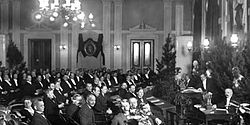
Local authorities is a generic term for the lowest tiers of public assistants within a detail sovereign state. This particular usage of the word government refers specifically to a level of administration that is both geographically-localised and has express powers. While in some countries, "government" is normally reserved purely for a national administration (government) (which may be known as a central regime or federal government), the term local government is always used specifically in contrast to national authorities – every bit well as, in many cases, the activities of sub-national, first-level administrative divisions (which are generally known past names such equally cantons, provinces, states, oblasts, or regions). Local governments generally deed only within powers specifically delegated to them past law and/or directives of a higher level of government. In federal states, local government by and large comprises a third or fourth tier of regime, whereas in unitary states, local authorities usually occupies the second or tertiary tier of government.
The question of municipal autonomy is a key question of public administration and governance. Local elections are held in many countries. The institutions of local government vary greatly betwixt countries, and even where similar arrangements exist, the terminology often varies. Common designated names for local government entities include state, province, region, canton, department, canton, prefecture, district, city, township, town, civic, parish, municipality, shire, village, ward, local service district and local government area.
Africa [edit]
Arab republic of egypt [edit]
Local government traditionally had limited ability in Egypt's highly centralized country. Under the central government were twenty-six governorates (sing., muhafazah; pl., muhafazat). These were subdivided into districts (sing., markaz; pl., marakaz) and villages (sing., qaryah; pl., qura) or towns. At each level, there was a governing structure that combined representative councils and government-appointed executive organs headed by governors, commune officers, and mayors, respectively. Governors were appointed past the president, and they, in turn, appointed subordinate executive officers. The coercive backbone of the state apparatus ran downwards from the Ministry building of Interior through the governors' executive organs to the district constabulary station and the village headman (sing., umdah; pl., umadah).[ citation needed ]
Before the revolution, country penetration of the rural areas was limited by the power of local notables, but under Nasser, land reform reduced their socioeconomic dominance, and the incorporation of peasants into cooperatives transferred mass dependence from landlords to authorities. The extension of officials into the countryside permitted the authorities to bring development and services to the hamlet. The local branches of the ruling political party, the Arab Socialist Spousal relationship (ASU), fostered a certain peasant political activism and coopted the local notables—in particular the village headmen—and checked their independence from the authorities.[ citation needed ]
Land penetration did non retreat under Sadat and Mubarak. The before effort to mobilize peasants and deliver services disappeared as the local political party and cooperative withered, but administrative controls over the peasants remained intact. The local power of the former families and the headmen revived but more than at the expense of peasants than of the state. The district police station balanced the notables, and the system of local authorities (the mayor and council) integrated them into the authorities.[ citation needed ]
Sadat took several measures to decentralize power to the provinces and towns. Governors acquired more authority under Law Number 43 of 1979, which reduced the authoritative and monetary controls of the primal government over the provinces. The elected councils acquired, at least formally, the right to approve or disapprove the local upkeep. In an try to reduce local demands on the primal treasury, local government was given wider powers to heighten local taxes. But local representative councils became vehicles of pressure level for regime spending, and the soaring deficits of local government bodies had to exist covered past the central government. Local government was encouraged to enter into joint ventures with private investors, and these ventures stimulated an alliance between government officials and the local rich that paralleled the infitah alliance at the national level. Nether Mubarak decentralization and local autonomy became more of a reality, and local policies ofttimes reflected special local conditions. Thus, officials in Upper Egypt oft bowed to the powerful Islamic movement in that location, while those in the port cities struck alliances with importers.[ citation needed ]
Mali [edit]
In contempo years, Mali has undertaken an ambitious decentralization programme, which involves the capital letter commune of Bamako, seven regions subdivided into 46 cercles, and 682 rural customs districts (communes). The state retains an informational role in administrative and fiscal matters, and information technology provides technical support, coordination, and legal recourse to these levels. Opportunities for straight political participation, and increased local responsibleness for development accept been improved.[ citation needed ]
In Baronial–September 1998, elections were held for urban council members, who afterwards elected their mayors. In May/June 1999, citizens of the communes elected their communal council members for the get-go time. Female voter turnout was about seventy% of the full, and observers considered the process open and transparent. With mayors, councils, and boards in identify at the local level, newly elected officials, civil club organizations, decentralized technical services, private sector interests, other communes, and donor groups began partnering to further evolution.[ citation needed ]
Eventually, the cercles will be reinstituted (formerly grouping arrondissements) with a legal and financial basis of their own. Their councils volition be chosen by and from members of the communal councils. The regions, at the highest decentralized level, volition have a similar legal and financial autonomy, and volition comprise a number of cercles within their geographical boundaries. Mali needs to build chapters at these levels, specially to mobilize and manage financial resources.[ commendation needed ]
Nigeria [edit]
Nigeria every bit a federal republic operates iii tiers of government: federal (or central), states and local regime. The country'southward constitution provides for each local regime (which exists in a single tier countrywide), and its development areas and autonomous communities created by individual state legislation to have democratically elected local government heads. There is a ministry (or bureau) of local government and chieftaincy affairs in each state charged with the responsibility of administration at that level. Nigeria has a total of 774 Local Government Areas (LGAs).[one]
South Africa [edit]
Southward Africa has a 2-tiered local regime system comprising local municipalities which autumn into district municipalities, and metropolitan municipalities which span both tiers of local government.
Asia [edit]
Afghanistan [edit]
Afghanistan was traditionally divided into provinces governed by centrally appointed governors with considerable autonomy in local affairs. There are currently 34 provinces. During the Soviet occupation and the development of country-wide resistance, local areas came increasingly under the control of mujaheddin groups that were largely independent of whatever college authority; local commanders, in some instances, asserted a measure of independence too from the mujaheddin leadership in Pakistan, establishing their ain systems of local regime, collecting revenues, running educational and other facilities, and fifty-fifty engaging in local negotiations. Mujaheddin groups retained links with the Peshawar parties to ensure access to weapons that were doled out to the parties past the government of Islamic republic of pakistan for distribution to fighters inside Afghanistan.[ citation needed ]
The Taliban set upwardly a shura (assembly), made upwards of senior Taliban members and of import tribal from the area. Each shura fabricated laws and collected taxes locally. The Taliban fix a provisional authorities for the whole of Afghanistan, only it did not practise primal command over the local shuras.[ citation needed ]
The procedure of setting up the transitional government in June 2002 past the Loya Jirga took many steps involving local government. Start, at the district and municipal level, traditional shura councils met to pick electors—persons who bandage ballots for Loya Jirga delegates. Each district or municipality had to choose a predetermined number of electors, based on the size of its population. The electors and so traveled to regional centers and cast ballots, to cull from amongst themselves a smaller number of loya jirga delegates— according to allotted numbers assigned to each commune. The delegates so took part in the Loya Jirga.[ citation needed ]
The warlords who rule various regions of the land exert local control. The transitional government is attempting to integrate local governing regime with the central government, only information technology lacks the loyalty from the warlords necessary to its governing authority. More than traditional elements of political authority—such equally Sufi networks, purple lineage, clan strength, historic period-based wisdom, and the similar—even so exist and play a role in Afghan society. Karzai is relying on these traditional sources of authority in his challenge to the warlords and older Islamist leaders. The deep indigenous, linguistic, sectarian, tribal, racial, and regional cleavages present in the country create what is chosen "Qawm" identity, emphasizing the local over college-lodge formations. Qawm refers to the group to which the private considers himself to belong, whether a subtribe, village, valley, or neighborhood. Local governing authority relies upon these forms of identity and loyalty.[ citation needed ]
Armenia [edit]
Armenia is subdivided into eleven authoritative divisions. Of these, ten are provinces, known as marzer ( մարզեր ) or in the singular course marz ( մարզ ) in Armenian.
Republic of azerbaijan [edit]
Azerbaijan is administratively divided into the following subdivisions:
- 59 districts (rayonlar; sing.– rayon),
- xi cities (şəhərlər; sing.– şəhər),
- i autonomous commonwealth (muxtar respublika), which itself contains:
- 7 districts
- ane urban center
The rayons are farther divided into municipalities (Bələdiyyə).
Bangladesh [edit]
People's republic of bangladesh is divided into eight authoritative divisions,[2] each named afterward their respective divisional headquarters: Barisal, Chittagong, Dhaka, Khulna, Rajshahi, Sylhet, Rangpur and Mymensingh Division.
Divisions are divided into zila. There are 64 zila in Bangladesh, each further divided into upazila or thana. The area inside each police station, except for those in metropolitan areas, is divided into several unions, with each wedlock consisting of multiple villages. In the metropolitan areas, police stations are divided into wards, which are further divided into mahallas. At that place are no directly elected officials at the divisional or district levels, although elected chairs of subdistricts also sit down on district councils.[3] Direct elections are held for each matrimony (or ward), electing a chairperson and a number of members. In 1997, a parliamentary human action was passed to reserve three seats (out of 12) in every matrimony for female candidates.[4] [5]
Dhaka is the capital and largest city of Bangladesh. The cities with a urban center corporation, having mayoral elections, include Dhaka South, Dhaka North, Chittagong, Khulna, Sylhet, Rajshahi, Barisal, Rangpur, Comilla and Gazipur. Other major cities, these and other municipalities electing a mayor and councilors for each ward, include Mymensingh, Gopalganj, Jessore, Bogra, Dinajpur, Saidapur, Narayanganj, Naogaon and Rangamati. Both the municipal heads are elected for a span of five years.
Brunei Darussalam [edit]
The administrative divisions of Brunei mainly consist of daerah, mukim and kampung or kampong. They are organised hierarchically, with daerah being the outset level and kampong the third level. All the authoritative divisions are nether direct governance of the government through the Ministry of Home Affairs. There are iv districts in Brunei: Negara brunei darussalam-Muara, Belait, Tutong and Temburong. The administrative level of mukim lies below the district. At present, there are 38 mukims, with 17 in Brunei-Muara, viii in Tutong, 8 in Belait and 5 in Temburong District. A mukim is headed by a penghulu. A village (Malay: kampung or kampong) is the lowest authoritative level in Negara brunei darussalam and headed by a ketua kampong or hamlet head. Its population varies from a few hundreds to tens of thousands.
Cambodia [edit]
China [edit]
Georgia [edit]
The subdivisions of Georgia are autonomous republics (Georgian: ავტონომიური რესპუბლიკა , avtonomiuri respublika), regions (მხარე, mkhare), and municipalities (მუნიციპალიტეტი, munits'ipaliteti).
Bharat [edit]
Indonesia [edit]
Islamic republic of iran [edit]
Iraq [edit]
Israel [edit]
The Israeli Ministry of Interior recognizes iv types of local government in Israel:[ commendation needed ]
- Cities: 71 single-level urban municipalities, usually with populations exceeding twenty,000 residents.
- Local councils: 141 single-level urban or rural municipalities, usually with populations betwixt 2,000 and 20,000.
- Regional Councils: 54 bi-level municipalities which govern multiple rural communities located in relative geographic vicinity. The number of residents in the individual communities normally does non exceed 2000. There are no clear limits to the population and land surface area size of Israeli regional councils.
- Industrial councils: Two unmarried-level municipalities which govern big and circuitous industrial areas outside cities. The local industrial councils are Tefen in Upper Galilee (north of Karmiel) and Ramat Hovav in the Negev (southward of Beer Sheva).
Japan [edit]
Since the Meiji restoration, Japan has had a local regime arrangement based on prefectures. The national government oversees much of the country. Municipal governments were historical villages. Now mergers are common for price effective administration. There are 47 prefectures. They have two principal responsibilities. Ane is mediation betwixt national and municipal governments. The other is area wide administration.
Kazakhstan [edit]
Korea, North [edit]
Korea, South [edit]
Malaysia [edit]
Local regime is the lowest level in the organisation of government in Malaysia—subsequently federal and state. It has the power to collect taxes (in the form of assessment tax), to create laws and rules (in the class of by-laws) and to grant licenses and permits for any trade in its area of jurisdiction, in add-on to providing basic amenities, collecting and managing waste and garbage as well every bit planning and developing the area under its jurisdiction.
Myanmar [edit]
Nepal [edit]
Gaunpalika (Rural Quango) and Nagarpalika (Municipal quango) are the local level divisions in Nepal. Which is ruled by third level of government subsequently Federal and Provincial government. In Nepal there are total 753 local levels authorities (including 6 Metropolises, eleven Sub-metropolises, 276 Municipalities and 460 Gaunpalikas). And there are total 6,743 wards are formed under these 753 local levels. These local government are ruled by local leaders and the Mayor is the supreme of each local government which is elected every 5 (5) year by local public.
Pakistan [edit]
Local government is the tertiary tier of government in Islamic republic of pakistan, after Federal Government and Provincial Authorities. There are 3 types of authoritative unit of local government in Pakistan:
- Commune Government Administrations
- Town Municipal Administrations
- Union Council Administrations
There are over five thousand local governments in Pakistan. Since 2001, these have been led by democratically elected local councils, each headed by a Nazim (the word means "supervisor" in Urdu, but is sometimes translated as Mayor). Some districts, incorporating large metropolitan areas, are called City Districts. A City Commune may contain subdivisions called Towns and Marriage Councils. Council elections are held every iv years. District Governments also include a District Coordination Officeholder (DCO), who is a civil servant in-accuse of all devolved departments. Currently, the Powers of Nazim are likewise held past the DCO.
[edit]
Local regime in the Palestinian National Authorization-controlled areas are divided into three chief groups: Municipal councils, village council and local evolution committees.
- Municipality (Palestinian Say-so): Depends on size of locality. Localities that serve as the centers of governorates and populations over 15,000 have 15-member councils. Localities with populations over 15,000 residents have 13-member councils and localities with populations betwixt four,000 and fifteen,000 have 9-member councils.
- Hamlet Council (Palestinian Potency): Localities with populations betwixt 800 and 1,500 have 3-member councils while those between 1,500 and −four,000 residents have vii-fellow member councils.
Philippines [edit]
The Local Government Code of 1991 provides for the iii levels of Local Government Units or LGUs in the Philippines: (one) the province (two) city and municipality, and (3) the barangay. The land remains a unitary land and the National Regime continues to accept strong influence over local government units.
A province is led past a governor along with the Sangguniang Panlalawigan (Provincial Council) equanimous of board members. A mayor leads a city or municipality while the Sangguniang Panlungsod (Urban center Council) and the Sangguniang Bayan (Municipal Council) establish the legislative branches of a city and municipality, respectively. A barangay is headed by the Barangay Captain and the Barangay Council. Barangays can be further divided into puroks and sitios merely their leadership is unelected.
The 1987 Philippine Constitution as well provides for the being of autonomous regions. The Bangsamoro Democratic Region in Muslim Mindanao (BARMM) is the only autonomous region in the Philippines. At that place was an endeavor to institute an democratic region in the Cordillera, just that failed and instead the Cordillera Administrative Region (Machine) was established.
Local governments have express taxing potency. Nigh of their funds come up from the national government via the Internal Revenue Resource allotment
Saudi Arabia [edit]
There are three levels of local authorities in the Kingdom of Saudi Arabia: the city council, the municipal council and the municipality.
The city council is the highest level of local authorities. The municipal councils began in 2005 and is the 2nd level of local government. The municipality is the third level of local government. There are 178 municipalities across the kingdom. The first began in Jeddah during the Othmanic period. Each municipality is run past its city'south mayor. As a commonage the kingdom's municipalities make up the Ministry building of Municipality and Rural Affairs (MoMRA).
Sri Lanka [edit]
Syria [edit]
Taiwan [edit]
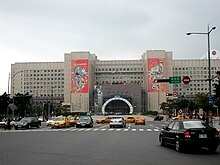
The Democracy of People's republic of china government in Taiwan consists of special municipality governments, provincial urban center governments and county governments for their local governments. They too have councils in each of those 3 local government levels.
Tajikistan [edit]
Thailand [edit]
Turkey [edit]
Turkey has two levels of local government; provinces (Turkish: iller ) and districts (Turkish: ilçeler ).
The territory of Turkey is subdivided into 81 provinces for authoritative purposes. The provinces are organized into vii regions for census purposes; yet, they do not correspond an administrative structure. Each province is divided into districts, for a total of 957 districts.
United Arab Emirates [edit]
Uzbekistan [edit]
Vietnam [edit]
Vietnam has 3 levels of local regime:
- Beginning tier: provinces and municipalities
- 2d tier: provincial cities, towns, urban districts and rural districts
- Third tier: wards, communes and townships
Each level has a People'due south Committee (executive – upwardly to third tier), a People's Quango (legislative – up to third tier) and a People's Court (judiciary – upward to second tier)
Yemen [edit]
Europe [edit]
Albania [edit]
Albania has 3 levels of local government :
- 12 administrative counties (Albanian: qark or prefekturë).
- 36 districts (Albanian: rreth).
- 373 municipalities (Albanian: bashki or komunë), 72 of which have metropolis status (Albanian: qytet).
There are overall 2980 villages/communities (Albanian: fshat) in all Albania. Each district has its council which is composed of a number of municipalities. The municipalities are the first level of local governance, responsible for local needs and constabulary enforcement.[six]
Andorra [edit]
Andorra is formed by seven parishes (parròquies, atypical – parròquia); Andorra la Vella, Canillo, Encamp, La Massana, Escaldes-Engordany, Ordino, Sant Julià de Lòria.
Some parishes have a farther territorial subdivision. Ordino, La Massana and Sant Julià de Lòria are subdivided into quarts (quarters), while Canillo is subdivided into 10 veïnats (neighborhoods). Those mostly coincide with villages, which are found in all parishes. Each parish has its own elected mayor who is the nominal head of the local authorities known every bit a comú in Catalan.
Republic of belarus [edit]
At the top level of administration, Belarus is divided into 6 regions and the city of Minsk, which has a special status being the upper-case letter of Belarus. Minsk is also the capital of Minsk Region.
At the second level, the regions are divided into raions ("districts").
Bulgaria [edit]
Since the 1880s, the number of territorial management units in Republic of bulgaria has varied from seven to 26.[7] Betwixt 1987 and 1999 the administrative structure consisted of 9 provinces (oblasti, atypical oblast). A new authoritative structure was adopted in parallel with the decentralisation of the economic arrangement.[eight] It includes 27 provinces and a metropolitan capital province (Sofia-Grad). All areas have their names from their respective majuscule cities. The provinces subdivide into 264 municipalities.
Municipalities are run by mayors, who are elected to iv-yr terms, and by directly elected municipal councils. Republic of bulgaria is a highly centralised state, where the national Council of Ministers directly appoints regional governors and all provinces and municipalities are heavily dependent on it for funding.[9]
Croatia [edit]
Croatia is divided into 20 counties and the capital city of Zagreb, the latter having the authority and legal status of a county and a city at the aforementioned time. The counties subdivide into 127 cities and 429 municipalities.[10]
Czech Commonwealth [edit]
The highest tier of local government in the Czech Republic are the xiii regions (Czech: kraje, atypical kraj) and the capital city of Prague. Each region has its ain elected Regional Associates (krajské zastupitelstvo) and hejtman (ordinarily translated as hetman or governor). In Prague, their powers are executed by the metropolis council and the mayor.
The regions are divided into 70-6 districts (okresy, atypical okres) including iii "statutory cities" (without Prague, which had special status). The districts lost most of their importance in 1999 in an administrative reform; they remain as territorial divisions and seats of various branches of country administration.[11] A farther reform in effect since January 2003 created 204 Municipalities with Extended Competence (obce s rozšířenou působností); also obce Iii. stupně – third-level municipalities, unofficially also chosen "little districts" (Czech: 'malé okresy') which took over nigh of the administration of the former district authorities. Some of these are farther divided between Municipalities with Commissioned Local Authorization (obce s pověřeným obecním úřadem, shortened to pověřená obec, pl. pověřené obce; "second-level municipalities"). In 2007 the borders of the districts were slightly adjusted and 119 municipalities are now within different districts.
Denmark [edit]
For local regime purposes, Denmark is divided into five regions (Danish: regioner), with their most important area of responsibleness being the public health service. They are also responsible for employment policies, and some regions are responsible for public mass transit. Regions are non entitled to levy their own taxes, and they rely entirely on key land funding (around 70%) and funding coming from the municipalities (around 30%). Regions are led past directly elected councils (regionsråd). They consist of 41 members each.
The regions are further divided into 98 municipalities (kommuner). Elections for the municipalities are held on the third Tuesday of Nov every iv years.
Republic of estonia [edit]
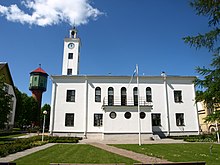
Estonia is divided into 79 municipalities (omavalitsus), and each municipality is a unit of measurement of self-government with its representative and executive bodies. Furthermore, the country is besides divided into fifteen counties (Estonian: maakonnad), each of which were used to be led by a county governor (maavanem), who represents the national government at the regional level. This although changed with 2017 administrative reform.
Finland [edit]

The virtually important administrative layer of local government in Finland are the 311 municipalities, which may also call themselves towns or cities. They account for half of public spending. Spending is financed by municipal income tax, property tax, state subsidies, and other revenue.
In addition to municipalities, at that place are ii intermediate levels of local regime. Municipalities co-operate in seventy-iv sub-regions and nineteen regions. These are governed by the member municipalities and have only limited powers. However, the autonomous province of Åland has a direct elected regional council, and the Sami people have a semi-autonomous Sami Domicile Area in Lapland for issues on language and civilisation.
France [edit]
According to its Constitution of 1958, France has 3 levels of local government:
- 13 Régions (including Corsica) and 5 Régions d'outre-mer (Réunion, Martinique, Mayotte, Guadeloupe and French Guiana). Corsica is non referred to as a "région" but simply as a "collectivité territoriale", that merely means "local regime surface area".
- 96 départements and 5 départements d'outre-mer (Réunion, Guadeloupe, Martinique, Mayotte and French Guiana). Paris is both a commune and a département.
- There are 36,679 municipalities (in French: Communes).
However, in addition to the constitutional clauses of 1958, at that place at present exist specificities:
- Intercommunalities are now a level of government betwixt municipalities and departments.
- There exist two "pays d'outre-mer": French Polynesia and New Caledonia. The expression "pays d'outre-mer" is user-friendly as it can be understood in French as both "overseas state" and "overseas county/traditional surface area" (every bit evidenced by Pays de la Loire that is a domicile région, not a abode "country"). French Polynesia works equally an autonomous région, whereas New Caledonia has a sui generis local government status with specific institutions and even more autonomy.
Federal republic of germany [edit]
Greece [edit]
Since 1 Jan 2011, Greece consists of 13 regions subdivided into a total of 325 municipalities and communities. The regions have their ain elected governors and regional councils, however there are seven decentralized administrations, which grouping from i to three regions under a government-appointed full general secretary. There is as well one democratic area, Mountain Athos.
Republic of hungary [edit]
For local authorities, Hungary is divided into nineteen counties. In addition, the capital (főváros), Budapest, is independent of any county government
The counties are further subdivided into 174 subregions (kistérségek), and Budapest is its own subregion.
In that location are also 23 towns with county rights (singular megyei jogú város). The local authorities of these towns accept extended powers, just these towns belong to the territory of the respective county instead of being contained territorial units.
Iceland [edit]
The Municipalities of Republic of iceland are local administrative areas in Iceland that provide a number of services to their inhabitants such as kindergartens, elementary schools, waste management, social services, public housing, public transportation, services to senior citizens and handicapped people. They besides govern zoning and tin can voluntarily take on additional functions if they have the budget for it. The autonomy of municipalities over their own matters is guaranteed by the constitution of Iceland.
The municipalities are governed past municipal councils which are directly elected every four years. The sizes of these councils vary from v members in the smallest municipalities to 15 in the largest 1. Nigh municipalities except for the very pocket-size ones rent an executive director who may or may non exist a member of the municipal council. These managers are usually referred to as mayors (bæjarstjóri / borgarstjóri) in the by and large urban municipalities just "commune manager" (sveitarstjóri) in the rural or mixed municipalities.
Republic of ireland [edit]
The Commonwealth of Ireland'south local government is laid out past the Local Authorities Reform Human activity 2014. With a few exceptions, local regime is two-tier. At the lowest level are the municipal, metropolitan or civic councils, which are elected during local elections. These councillors from the relevant canton then together class the council, termed either County or Metropolis and County Councils. For example, the 4 municipal districts in Westmeath County each elect their own councils, who together course Westmeath County Council. Many functions are performed by the Chief Executive, who is appointed by the Government minister for Local Government.
The exceptions to the above is the county of Dublin and the cities of Cork and Galway, the later on 2's councils are directly elected with no lower council. Dublin canton is made upward of iv local area authorities, each elected directly. At that place are thirty-i local authorities.
The main sources of funding for local government in Ireland are local property and motor revenue enhancement revenues, payments from the Exchequer, charges for goods and services, and state grants.[12]
Isle of man [edit]
Local government on the Mann is partly based on the aboriginal parishes. There are four types of local authorities: a borough corporation, town commissioners, village commissioners, and parish commissioners.
Italy [edit]
The Italian Constitution defines 3 levels of local authorities:
- Regions: At nowadays 5 of them (Valle d'Aosta, Friuli-Venezia Giulia, Trentino-Alto Adige, Sardinia and Sicily) have a special condition and are given more than ability than the others. The constitutional reform of 2001 gave more power to regions.
- Provinces: They more often than not intendance to roads, forests, and education. They had more ability in the by.
- Communes: The Mayor and staff, caring for the needs of a single town or of a hamlet and neighbouring small-scale towns or villages.
Major cities also have an extra tier of local government named Circoscrizione di Decentramento Comunale or, in some cities (e.g. Rome) Municipio.
Republic of latvia [edit]
Latvia is a unitary state, currently divided into 110 municipalities (Latvian: novadi) and 9 republican cities (Latvian: republikas pilsētas) with their own quango.
Liechtenstein [edit]
Liechtenstein is divided into xi municipalities (Gemeinden – atypical Gemeinde), near consisting of only a single town.
Lithuania [edit]
| | This article needs to exist updated. (June 2013) |

Republic of lithuania has a three-tier division of local government: the land is divided into x counties (Lithuanian: singular – apskritis, plural – apskritys) that are further subdivided into lx municipalities (Lithuanian: singular – savivaldybė, plural – savivaldybės) which consist of over 500 elderships (Lithuanian: singular – seniūnija, plural – seniūnijos).
The counties are ruled past county governors (Lithuanian: apskrities viršininkas) appointed past the central government, and effectively oversee the 2 lower tiers of local government.
Municipalities are the nearly important administrative unit of local government. Each municipality has its ain government and quango, with elections taking identify every iv years. The mayor, who is a member of the council, is elected directly by the residents in a majority vote.[xiii] The quango appoints elders to govern the elderships.
Elderships, numbering over 500, are the smallest units of local government. They provide public services such as registering births and deaths and identifying individuals or families in need of welfare.
Malta [edit]
Malta is a unitary urban center state divided into 68 municipalities (local councils), co-ordinate to the constitution of the Republic of malta.
Netherlands [edit]
Holland has three tiers of local government: national, provincial, municipal and water board.
Kingdom of the netherlands is divided into twelve provinces (provincie, pl. provincies). They form the tier of administration between the central government and the municipalities. Each province is governed by a provincial council, usa-Provincial (Provinciale Staten, abbr. to PS). Its members are elected every four years. The day-to-day management of the province is in the hands of the provincial executive, us Deputed (Gedeputeerde Staten, abbr. to GS). Members of the executive are chosen by the provincial council. The size of the executive varies from one province to another. In Flevoland, the smallest of the Dutch provinces, it has four members, while most other provinces have 6 or seven. Meetings of the provincial executive are chaired by the King's Commissioner (Commissaris van de Koning(in), abbr. to CvdK). The Male monarch's Commissioner is not elected past the residents of the province, but appointed past the Crown (the King and government ministers). The appointment is for six years and may exist extended by a 2nd term. The King's Commissioner can be dismissed only by the Crown. Rex'southward Commissioners play an important part in the appointment of municipal mayors. When a vacancy arises, the King's Commissioner first asks the municipal council for its views equally to a successor, then writes to the Minister of the Interior recommending a candidate.
Municipalities (gemeente, pl. gemeenten) form the lowest tier of government in the netherlands, after the key regime and the provinces. There are 415 of them (one January 2012). The municipal council (gemeenteraad) is the highest potency in the municipality. Its members are elected every four years. The role of the municipal council is comparable to that of the board of an organisation or institution. Its main task is to decide the municipality'south wide policies and to oversee their implementation. The 24-hour interval-to-day assistants of the municipality is in the hands of the municipal executive (higher van burgemeester en wethouders, abbr. to (college van) B&W), made up of the mayor (burgemeester) and the aldermen (wethouder, pl. wethouders). The executive implements national legislation on matters such as social help, unemployment benefits and environmental management. It also bears primary responsibility for the fiscal diplomacy of the municipality and for its personnel policies. Aldermen are appointed by the council. Councillors tin be called to deed as aldermen. In that instance, they lose their seats on the quango and their places are taken by other representatives of the aforementioned political parties. Non-councillors can also be appointed. Unlike councillors and aldermen, mayors are not elected (not fifty-fifty indirectly), only are appointed by the Crown. Mayors chair both the municipal council and the executive. They accept a number of statutory powers and responsibilities of their ain. They are responsible for maintaining public lodge and safety within the municipality and frequently manage the municipality's public relations. As Crown appointees, mayors too have some responsibility for overseeing the work of the municipality, its policies and relations with other government bodies. Although they are obliged to acquit out the decisions of the municipal quango and executive, they may recommend that the Minister of the Interior quash any conclusion that they believe to be contrary to the law or confronting the public involvement. Mayors are invariably appointed for a period of six years. They can exist dismissed only by the Crown and not by the municipal council.
Water boards (waterschap and hoogheemraadschap, pl. waterschappen and hoogheemraadschappen) are among the oldest authorities regime in the netherlands. They literally form the foundation of the whole Dutch organisation of local government; from time immemorial they have shouldered the responsibility for water management for the residents of their expanse. In polders this mainly involves regulating the h2o level. It has always been in the common interest to go on water out and polder residents have ever had to work together. That is what led to the creation of water boards. The structure of the water boards varies, just they all have a full general authoritative body and an executive lath (college van dijkgraaf en heemraden) consisting of a chairperson (dijkgraaf) and other members ((hoog)heemraad, pl. (hoog)heemraden). The chairperson likewise presides the general administrative torso. This trunk consists of people representing the diverse categories of stakeholders: landholders, leaseholders, owners of buildings, companies and, since recently, all the residents besides. Importance and fiscal contribution decide how many representatives each category may delegate. Sure stakeholders (e.g. environmental organisations) may exist given the power to appoint members. The full general authoritative body elects the executive lath from among its members. The government appoints the chairperson for a period of six years. The general administrative torso is elected for a period of 4 years. In the past the administrative organ was elected as individuals simply from 2009 they will be elected as political party representatives.
Norway [edit]
Norway's regional assistants is organised in xix counties (fylke), with 18 of them subdivided into 431 municipalities (kommune) per 1 January 2006. The municipal sector is a provider of vital services to the Norwegian public, accounting for nearly 20% of Norwegian GNP and 24% of full employment. Norway had 435 municipalities of varying size in 2003, each administered past an elected municipal quango. They are grouped into 19 counties (fylker), each governed by an elected canton council. Each canton is headed by a governor appointed by the rex in council. Oslo is the only urban eye that alone constitutes a county; the remaining eighteen counties consist of both urban and rural areas. County and municipal councils are popularly elected every 4 years. The municipalities accept wide powers over the local economic system, with the state exercising strict supervision. They have the right to taxation and to utilise their resource to support education, libraries, social security, and public works such as streetcar lines, gas and electricity works, roads, and town planning, only they are ordinarily aided in these activities past country funds.
Portugal [edit]
Currently, mainland Portugal is divided into 18 districts (in Portuguese, distritos). Each district takes the name of their respective capital letter urban center. Insular Portugal, comprising the 2 Atlantic archipelagos of the Azores and Madeira, is organized equally two autonomous regions (in Portuguese, regiões autónomas).
Each district and each Autonomous region is divided into municipalities (in Portuguese, municípios) which, in turn, are subdivided into parishes (in Portuguese, freguesias).
Since 1976, when the two Autonomous regions of Portugal were established, the Azores and Madeira are no longer divided into districts.
Poland [edit]
Poland has three levels of subdivision. The territory of Poland is divided into 16 voivodeships (provinces); these are farther divided into 379 powiats (counties or districts), and these in plough are divided into 2,479 gminas (communes or municipalities). Major cities normally have the status of both gmina and powiat.
Each voivodeship is jointly governed by the National-government appointed voivode and a locally elected sejmik (provincial assembly), which appoints an executive board led by a voivodeship marshal.
Russia [edit]
The Russia consistes of fourscore-v federal subjects that are elective members of the Federation. However, two of these federal subjects — the Democracy of Crimea and the federal city of Sevastopol—are internationally recognized as role of Ukraine. All federal subjects are of equal federal rights in the sense that they have equal representation—two delegates each—in the Federation Council (upper house of the Federal Assembly). But they exercise differ in the degree of autonomy they savor.
The modern authoritative-territorial structures of the federal subjects vary significantly from one federal field of study to some other. While the implementation details may be considerably different, in full general, however, the following types of loftier-level administrative divisions are recognized:
- administrative districts (raions)
- cities/towns and urban-type settlements of federal subject significance
- closed administrative-territorial formations
Typical lower-level authoritative divisions include:
- selsoviets (rural councils)
- towns and urban-type settlements of the administrative commune significance
- city districts
Spain [edit]
Spain is divided into 17 democratic communities, which in turn are divided into 50 provinces. There are also ii autonomous cities: those of Ceuta and Melilla. Finally, each province comprises a number of municipalities.
Each administrative entity is given powers, structure, and boundaries past a law that was passed by the Prime Minister .
Law seven/1985,[14] passed by the old Spanish Prime Minister Felipe González Márquez (socialist), lays down the process of the Local Government. Every city in Spain used this Law until 2003. This yr, the former Spanish Prime Minister José María Aznar López (conservative), passed a Law (57/2003)[xv] to modernize organic rules of those cities which had more than 250,000 inhabitants, and other of import cities (like capital cities of provinces with at least 175,000 inhabitants). Also, it exists two other important Laws for specifically Madrid (Police 22/2006)[16] and Barcelona (Law ane/2006).[17] The main governing body in well-nigh municipalities is chosen Ayuntamiento (in the less populated municipalities an culling local organization system called open quango, "concejo abierto", is used). The Ayuntamiento in turn is formed by the Plenary (el Pleno, the collective formed past the city councillors) and the Mayor. The number of members that etch The Plenary varies depending on city'due south population (for example, since 2007 Valencia has 33 members and Pamplona has 27). The name given to the members of the Plenary is councillor (concejal). Those councillors are elected between city's inhabitants every four years by directly vote. Subsequently being elected, councillors encounter in a special Plenary session to decide who volition be elected, between them, equally city'southward Mayor. In the next days afterwards the ballot, the mayor chooses some councillors to set up the executive governing body (Junta de Gobierno or Comisión de Gobierno). After that, and for the side by side four years, city's mayor and the Junta de Gobierno will govern over the city according to their competences (urbanism, some taxes, local police, licenses for specific activities, cleaning services, etc.). Meanwhile, councillors in the Plenary merely not part of the Junta de Gobierno (the opposition) will oversee Mayor's rule. The autonomous community of Catalonia is divided in iv provinces and more than than 900 municipalities. Between these two tiers, there are 41 comarques (singular, comarca), roughly equivalent to 'commune' or 'canton'. The comarca is a commonwealth, or union, of municipalities with competences in several fields (Constabulary half dozen/1987 of the Parliament of Catalonia).
Sweden [edit]
Every fourth yr general elections are held in Sweden to elect members of the national parliament, 20 county council assemblies and 290 municipal assemblies. As the parliament elects the national government, the local assemblies elect their executive committees and their boards. Members in local committees and boards are elected proportionally by the political parties in the assemblies, giving all the major parties representation. The parties unremarkably cooperate well on the local levels.
The county councils (landsting) are responsible for health care and usually provide transportation.
The municipalities (kommuner) are responsible for:
- social services, childcare, preschool, elderly care
- primary and secondary education
- planning and building
- health protection, h2o, sewerage, refuse, emergency services
On a voluntary basis, the municipalities provide sports, culture, housing, energy likewise as commercial service.
The activities are financed past income taxes. Swedes pay around twenty% of their taxable income to the municipality and effectually 11% to the county quango. (The national government is financed past VAT and payroll taxes and fees.)
Ukraine [edit]
United Kingdom [edit]
The system of local government is dissimilar in each of the four home nations of the UK. In full there are 426 local authorities in the United kingdom of great britain and northern ireland. 346 of these are in England, xi in Northern Ireland, 32 in Scotland and 22 are in Wales.
England [edit]
The virtually complex system is in England, the result of numerous reforms and reorganisation over the centuries. The top-level of sub-national administration inside England until the end of March 2012 consisted of the 9 regions. The regions were used past central government for various statistical purposes, and Authorities Offices and assorted other institutions including Regional Development Agencies. Regional Government Offices, Regional Development Agencies and Regional Ministers were all abolished by the Cameron ministry in 2010. Just the London region which is a sub-region compared to the other regions of England has a directly elected authorities. Only one regional plebiscite has been held to date to seek consent for the introduction of direct elections elsewhere — in the northeast of England — and this was overwhelmingly rejected past the electorate.
The layers of elected local government vary. In different areas the highest tier of elected local authorities may be:
- counties, which may be
- single-tier unitary authorities, or
- divided into districts (likewise known equally boroughs in some areas)
- districts, which are separate unitary authorities in some areas
- metropolitan districts (also chosen metropolitan boroughs) in some areas which are similar to unitary authorities, merely have articulation boards with other districts in the same metropolitan canton
- Greater London, which is divided into 32 London boroughs and the Urban center of London
In well-nigh areas there is a lower tier of government, civil parishes, with limited functions. Virtually ceremonious parishes are in rural areas, but if the parish is a town the parish council may be called a boondocks quango. In a few cases the parish is a metropolis, and the parish quango is chosen a city council.
Metropolitan counties, and a few not-metropolitan counties, no longer accept elected councils or administrative functions, and their former functions are performed by districts. Such counties remain ceremonial counties.
Northern Republic of ireland [edit]
Since ane Apr 2015 Northern Ireland is divided into eleven districts. Local regime in Northern Ireland does not carry out the same range of functions as those in the residual of the Uk.
Scotland [edit]
Local regime in Scotland is arranged on the lines of unitary regime, with the nation divided into 32 council areas.
Wales [edit]
Wales has a compatible system of 22 unitary authorities, variously styled every bit county, county borough, urban center or metropolis and canton local authorities. There are likewise communities, equivalent to parishes.
North America [edit]
Canada [edit]
Canada has a federal system with three orders of government. The largest is the federal government, followed by the provincial and local governments.[18] Municipal governments are separately elected. They must follow laws and guidelines equally set out by their province, but are allowed to laissez passer boosted by-laws and acts unique to them.
United mexican states [edit]
United mexican states is a Federal Republic made up by 31 states and a federal district. Each state is divided in municipios, while the federal district is divided in 16 delegaciones. Twenty-9 states of Mexico were created equally administrative divisions by the constitution of 1917, which grants them those powers not expressly vested in the federal government; Mexico's 2 remaining territories, Baja California Sur and Quintana Roo, achieved statehood on 9 October 1974, raising the total to 31. Each country has a constitution, a governor elected for six years, and a unicameral legislature, with representatives elected by district vote in proportion to population. An ordinary session of the legislature is held annually, and extraordinary sessions may be called by the governor or the permanent committee. Bills may exist introduced by legislators, past the governor, by the state supreme court, and past municipalities (a unit comparable to a US county). In improver to the 31 states, there is also one federal district comprising Mexico Metropolis, whose governor serves equally a member of the cabinet. Many state services are supported by federal subsidies.
The main unit of country government is the municipality. Mexico's 2,378 municipalities are governed past municipal presidents and municipal councils. State governors generally select the nominees for the municipal elections. Municipal budgets are canonical past the respective state governors. Until 1997, the president appointed the mayor of Mexico City. Political reforms immune the starting time open elections in 1997, and Cuauhtémoc Cardenas Solórzano became Mexico City'southward start elected mayor.
Usa [edit]

Local government in the United states refers to governmental jurisdictions below the level of the state. Nigh states accept at to the lowest degree two tiers of local authorities: counties and municipalities. In some states, counties are divided into townships. There are several different types of jurisdictions at the municipal level, including the urban center, boondocks, parish, civic, village, reservations and boundaries. The types and nature of these municipal entities varies from state to state.
Oceania [edit]
Australia [edit]
Local government is the third type of regime in Australia, later on Federal and State.
New Zealand [edit]
New Zealand has a local regime system comprising two complementary sets of local government—regional councils and territorial authorities. There are 78 local authorities consisting of:
- xi regional councils, which cover much of New Zealand's land area, and
- 67 territorial authorities (comprising 53 commune councils, 12 urban center councils and 2 other councils).
Half dozen of the territorial authorities are unitary authorities, which also take the powers of a regional council. They are Auckland Quango, Nelson City Council, the Gisborne, Marlborough and Tasman district councils, and Chatham Islands Council.
Regional council areas are based on h2o catchment areas, whereas territorial authorities are based on community of interest and road access. Within a regional quango area in that location are commonly many city or district councils, although city and district councils tin can be in multiple regional council areas.
Due south America [edit]
Argentina [edit]
Argentina is a federation of 23 provinces and the federal capital of Buenos Aires. During the 19th century at that place was a bitter struggle betwixt Buenos Aires and the interior provinces, and there has long been an element of tension regarding the division of powers betwixt the central government and provincial bodies. The federal government retains control over such matters as the regulation of commerce, community collections, currency, ceremonious or commercial codes, or the date of foreign agents. The provincial governors are elected every four years.
The ramble "national intervention" and "state of siege" powers of the president have been invoked oft. The first of these powers was designed to "guarantee the republican form of government in the provinces." Since the adoption of the 1853 constitution, the federal government has intervened over 200 times, generally by presidential decree. Under this authorization, provincial and municipal offices may be alleged vacant, appointments annulled, and local elections supervised. Betwixt 1966 and 1973, all local legislatures were dissolved and provincial governors were appointed by the new president. A restoration of provincial and municipal regime followed the return to constitutional regime in 1973. After the March 1976 coup, the federal regime once more intervened to remove all provincial governors and impose direct military rule over all municipalities. Since 1983, representative local government has been in strength over again.
Until 1996, the President appointed the mayor of Buenos Aires, and past police, the president and Congress controlled whatsoever legislation that affected the urban center. Constitutional reforms that year led to an elected mayoral position, and a 60-member Poder Legislativo (legislative power).
Brazil [edit]
Brazil is a federation consisting of 27 federative units: 26 states and ane Federal District. Government exists at 3 levels: federal, state, and municipal. U.s. are subdivided into 5,570 municipalities, while the Federal District has no municipalities (divided into administrative regions instead) and has powers of both a land and a municipality..
Municipal regime consists of an executive co-operative headed by a mayor (Prefeito/Prefeita), and a legislative co-operative (Câmara Municipal), serving iv-yr terms. Municipalities are enshrined in the constitution of 1988 as entities of the federation; their responsibilities are singled-out from the other two levels in theory,[nineteen] but overlap in practise (eg. education, health, transportation).[20] With their broad powers, municipalities may create their own constitutions, termed organic law, and cannot be overruled past country governments.[20]
Elections at the municipal level follow a similar, partisan system to land and federal elections, but accept identify in dissimilar years. Municipalities may take anywhere from ix to 55 members of the Câmara Municipal, depending on the population.[21] There is no minimum or maximum population requirement for municipalities: while the average population of a municipality in 2005 was 30,099, Borá, São Paulo state (the to the lowest degree populous) had merely 823 inhabitants, while São Paulo (the largest) had 10.9 million inhabitants.[20] Municipalities inside a state may cull to merge or separate with approval in a plebiscite and enacting of a state law.[22]
Paraguay [edit]
Paraguay is divided into 17 departments, which are subdivided into districts, which, in turn, comprise municipalities (the minimum requirement for a municipality is 3,000 persons) and rural districts (partidos). A governor, elected by popular vote, runs each section. Municipal government is exercised through a municipal board, chosen past directly election, and an executive department. In the master cities and capitals, the executive department is headed by a mayor appointed by the minister of the interior; in other localities, the mayor is appointed by the presidents of the municipal boards. Police chiefs are appointed past the central government.
Peru [edit]
Peru is divided into 25 regions and the province of Lima. Each region has an elected government composed of a president and council that serve four-twelvemonth terms.[23] These governments programme regional development, execute public investment projects, promote economic activities, and manage public property.[24] The province of Lima is administered by a urban center council.[25] The goal of devolving ability to regional and municipal governments was among others to improve popular participation. NGOs played an important part in the decentralisation procedure and notwithstanding influence local politics.[26]
Uruguay [edit]
Uruguay's administrative subdivisions consisted of xix territories called departments and governed by intendencias, which were subordinate to the central government and responsible for local assistants. They enforced national laws and administered the nation's social and educational policies and institutions inside their territories. These territories had limited taxing powers, but they could borrow funds and acquire belongings. They also had the ability to plant unpaid v-member local boards or town councils in municipalities other than the departmental capital letter if the population was big plenty to warrant such a torso.
Executive authority was vested in a governor (intendente), who administered the department, and in a thirty-one-member departmental board (junta departmental), which carried out legislative functions. These functions included approval of the departmental upkeep and judicial deportment, such as impeachment proceedings against departmental officials, including the governor. At the municipal level, a mayor (intendente municipal) assumed executive and administrative duties, carrying out resolutions made past the local board (whose members were appointed on the basis of proportional representation of the political parties). The governor was required to comply with and enforce the constitution and the laws and to promulgate the decrees enacted past the departmental board. The governor was authorized to set the budget, submit it for blessing to the departmental lath, appoint the board'southward employees, and, if necessary, subject field or suspend them. The governor represented the department in its relations with the national government and other departmental governments and in the negotiation of contracts with public or private agencies.
Similar the governor, the members of the departmental board and the mayor were elected for five-year terms in direct, pop elections. A governor could exist reelected only once, and candidates for the mail had to meet the same requirements every bit those for a senator, in addition to being a native of the department or a resident therein for at least three years before assuming office. Departmental lath members had to exist at least twenty-3 years of historic period, native born (or a legal citizen for at least three years), and a native of the section (or a resident for at least three years).
The lath saturday in the capital city of each section and exercised jurisdiction throughout the unabridged territory of the section. Information technology could issue decrees and resolutions that it deemed necessary either on the suggestion of the governor or on its own initiative. It could approve budgets, set up the amount of taxes, request the intervention of the Accounts Tribunal for advice concerning departmental finances or administration, and remove from part—at the request of the governor—members of nonelective local departmental boards. The lath also supervised local public services; public health; and principal, secondary, preparatory, industrial, and artistic education. Although Montevideo was the smallest department in terms of expanse (divided into 20-three geographic zones that generally coincided with the balloter zones), its departmental lath had sixty-five members in 1990; all other departments had xxx-ane-member boards and a five-member executive quango appointed past the departmental lath, with proportional representation from the principal political parties.
Data as of Dec 1990[ citation needed ]
References [edit]
- ^ Country Profile 2019 [The Local Government System in Nigeria] (PDF). p. 161. Retrieved February 26, 2021.
- ^ "Rangpur becomes a sectionalisation". bdnews24.com. 25 January 2010. Archived from the original on seven April 2013. Retrieved 6 Baronial 2011.
- ^ Siddiqui, Kamal (2012). "Local Government". In Islam, Sirajul; Jamal, Ahmed A. (eds.). Banglapedia: National Encyclopedia of Bangladesh (2d ed.). Asiatic Society of Bangladesh.
- ^ Local Government Act, No. xx, 1997.
- ^ "Strengthen Local Government Towards Deepening Democracy: Annual written report 2012–2013" (PDF). Bangladesh Mahila Parishad. Retrieved 31 March 2014.
- ^ "On the Organisation and Operation of the Local Government, Democracy of Republic of albania, 2000" (PDF). Archived from the original (PDF) on 15 Feb 2010. Retrieved 27 August 2010.
- ^ "Историческо развитие на административно – териториалното устройство на Република България" (in Bulgarian). Ministry of Regional Development. Retrieved 26 December 2011.
- ^ "Областите в България. Портрети". Ministry of Regional Development. Retrieved 4 December 2011.
- ^ Library of Congress 2006, p. 17. sfn fault: no target: CITEREFLibrary_of_Congress2006 (aid)
- ^ "Zakon o područjima županija, gradova i općina u Republici Hrvatskoj" [Territories of Counties, Cities and Municipalities of the Republic of Croatia Act]. Narodne novine (in Croation). 28 July 2006. Retrieved 9 September 2011.
- ^ The death of the districts, Radio Prague 3 Jan 2003.
- ^ "Local government facts and figures: Ireland". lgiu.org . Retrieved 2021-ten-01 .
- ^ Suvestinių redakcijų sąrašas pagal datą Listing on the website eastward-seimas.lrs.lt. Retrieved 30 March 2021.
- ^ Ley 7/1985, de 2 de abril, Reguladora de las Bases del Régimen Local. Noticias.juridicas.com. Retrieved on 2 December 2012.
- ^ Ley 57/2003, de 16 de diciembre, de medidas para la modernización del gobierno local. Noticias.juridicas.com. Retrieved on 2 December 2012.
- ^ Ley 22/2006, de iv de julio, de Capitalidad y de Régimen Especial de Madrid. Noticias.juridicas.com. Retrieved on ii Dec 2012.
- ^ Ley 1/2006, de 13 de marzo, por la que se regula el Régimen Especial del municipio de Barcelona. Noticias.juridicas.com. Retrieved on two Dec 2012.
- ^ Fact Canvass: Regime in Canada Archived 2009-03-03 at the Wayback Machine. Cic.gc.ca (2010-08-23). Retrieved on 2 December 2012.
- ^ "CONSTITUIÇÃO DA REPÚBLICA FEDERATIVA DO BRASIL - 1988". Presidência da República Casa Ceremonious: Subchefia para Assuntos Jurídicos. Championship 3, Affiliate Four, Art. thirty. Retrieved 2021-05-01 .
{{cite web}}: CS1 maint: url-status (link) - ^ a b c Afonso, José; Araújo, Erika (2007-01-11). "Local Regime Organization and Finance: Brazil". The World Bank. Public Sector Governance and Accountability Series. Rochester, NY. Local Governance in Developing Countries: 381–418. SSRN 2548199 – via SSRN.
- ^ "CONSTITUIÇÃO DA REPÚBLICA FEDERATIVA Practise BRASIL - 1988". Presidência da República Casa Civil: Subchefia para Assuntos Jurídicos. Title 3, Chapter Four, Art. 29, Sec. Four. Retrieved 2021-05-01 .
{{cite web}}: CS1 maint: url-status (link) - ^ "CONSTITUIÇÃO DA REPÚBLICA FEDERATIVA Practise BRASIL - 1988". Presidência da República Casa Civil: Subchefia para Assuntos Jurídicos. Title 3, Chapter I, Fine art. xviii, Sec. 4. Retrieved 2021-05-01 .
{{cite web}}: CS1 maint: url-status (link) - ^ Ley N° 27867, Ley Orgánica de Gobiernos Regionales, Article N° xi.
- ^ Ley N° 27867, Ley Orgánica de Gobiernos Regionales, Article North° 10.
- ^ Ley North° 27867, Ley Orgánica de Gobiernos Regionales, Article N° 66.
- ^ Monika Huber, Wolfgang Kaiser (February 2013). "Mixed Feelings". dandc.european union.
Further reading [edit]
- Kemp, Roger L. Managing America'south Cities: A Handbook for Local Government Productivity, McFarland and Co., Jefferson, NC, USA, and London, Eng., Britain 1998 (ISBN 0-7864-0408-6).
- Kemp, Roger Fifty. Model Regime Charters: A City, County, Regional, Land, and Federal Handbook, McFarland and Co., Jefferson, NC, United states of america, and London, Eng., Great britain, 2003 (ISBN 978-0-7864-3154-0).
- Kemp, Roger L. Forms of Local Government: A Handbook on City, County and Regional Options, McFarland and Co., Jefferson, NC, United states of america, and London, Eng., UK, 2007 (ISBN 978-0-7864-3100-7).
- Lockner, Allyn O. Steps to Local Government Reform: A Guide to Tailoring Local Authorities Reforms to Fit Regional Governance Communities in Democracies. iUniverse, Bloomington, Indiana, USA, 2013 (ISBN 978-i-4620-1819-two).
External links [edit]
- Department of Local and Regional Democracy and Good Governance—Quango of Europe
- The Congress in brief
- Rural local self-government challenges and evolution prospects by Rukhman Adukov
- Women in Governance, Republic of india on YouTube
- Using a Model Municipal Functioning Measurement System to Assess Mid-sized Texas Cities.
- Factors Contributing to Municipal Looting among Medium Sized Southern U.s. Cities. Colin Rice
- United Cities and Local Governments is an organisation for cities, local governments and municipal associations throughout the globe.
- Agenda 21 for culture is the reference certificate for cultural programmes of local authorities
- Rural Decentralization and Local Governance provides free access to selected east-resources and news on local governance in developing countries.
- Governance From Below Free to download studies, papers, information, and other resources on local government, decentralization and federalism.

Which Service Is Performed By Local Government,
Source: https://en.wikipedia.org/wiki/Local_government
Posted by: santeevortunfir.blogspot.com
0 Response to "Which Service Is Performed By Local Government"
Post a Comment