

Can My Service Dog Be Carried In My Own Cart

A cart or dray (Aus. & NZ[one]) is a vehicle designed for transport, using two wheels and normally pulled by i or a pair of draught animals. A handcart is pulled or pushed by i or more people.
It is different from the flatbed trolley also known as a dray, (for freight) or wagon, which is a heavy transport vehicle with four wheels and typically two or more humans.
Over time, the term "cart" has come to mean nearly any small conveyance, including shopping carts, golf carts, gokarts, and UTVs, without regard to number of wheels, load carried, or means of propulsion.
The draught animals used for carts may be horses, donkeys or mules, oxen, and even smaller animals such equally goats or large dogs.
History [edit]

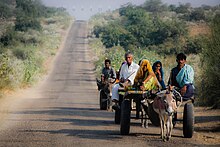
Ass cart is most ordinarily used for transportation in Thar desert
Carts take been mentioned in literature as far back as the 2nd millennium B.C. Handcarts pushed by humans accept been used effectually the world. In the 19th century, for instance, some Mormons traveling across the plains of the The states between 1856 and 1860 used handcarts.[two]
The history of the cart is closely tied to the history of the wheel.
Carts were often used for judicial punishments, both to transport the condemned – a public humiliation in itself (in Ancient Rome defeated leaders were often carried in the victorious general's triumph) – and even, in England until its commutation by the whipping post nether Queen Elizabeth I, to necktie the condemned to the cart-tail and administer him or her a public whipping. Tumbrils were normally associated with the French Revolution as a mobile stage elevating the condemned on the way to the guillotine: this was simply a continuation of earlier practice when they were used equally the removable support in the gallows, earlier Albert Pierrepoint calculated the precise driblet needed for instant severance of the nerve cavalcade.
Types of carts [edit]
Larger carts may be drawn by animals, such as horses, mules, or oxen. They take been in continuous use since the invention of the wheel, in the 4th millennium BC. Carts may be named for the animate being that pulls them, such as horsecart or oxcart. In modern times, horsecarts are used in competition while typhoon horse showing. A dogcart, all the same, is normally a cart designed to carry hunting dogs: an open up cart with two cross-seats dorsum to back; the dogs could be penned between the rear-facing seat and the back terminate.
The term "cart" (synonymous in this sense with chair) is likewise used for various kinds of lightweight, two-wheeled carriages, some of them sprung carts (or bound carts), especially those used as open pleasure or sporting vehicles. They could exist drawn by a horse, pony or dog. Examples include:
- Cocking cart: short-bodied, high, two-wheeled, seat for a groom behind the box; for tandem driving[3]
- Dead cart to carry victims of the plague[four] [v]
- Dogcart: lite, unremarkably one horse, commonly 2-wheeled and high, two transverse seats gear up back to dorsum
- Donkey cart: underslung axle, ii lengthwise seats; also called pony cart, tub-cart
- float : a dropped beam to give an peculiarly depression loadbed, for carrying heavy or unstable items such as milk churns. The name survives today as a milkfloat.
- Governess cart: lite, two-wheeled, entered from the rear, trunk partly or wholly of wickerwork, seat for two persons along each side; also called governess auto, tub-cart
- Ralli cart: calorie-free, 2-wheeled, horse-fatigued, for two persons facing frontward, or iv, two facing forward and 2 rearward. The seat is adjustable fore-and-aft to go along the vehicle balanced for two or four people.
- Stolkjaerre: two-wheeled, front seat for 2, rear seat for the driver; used in Kingdom of norway
- Tax cart: spring cart, formerly subject to a small tax in England; as well chosen taxed cart
- Whitechapel cart: spring cart, light, two-wheeled, especially for family or lite commitment service[6] [7] [8]
- Pushcart, a cart that is pushed past i or more persons:
- Luggage cart, pushed past travelers to behave individual luggage
- Serving cart, as well known as pushcart or go-cart, is a handcart used for serving:
- Food cart, a mobile kitchen that is gear up on the street to facilitate the sale and marketing of street food to people from the local pedestrian traffic.
- Food service cart, likewise named serving trolley, for serving the nutrient in a eatery
- Pastry cart, for serving pastry
- Tea cart, also named teacart, tea trolley and tea wagon, for serving tea or other drinks
The architect of a cart may be known as a cartwright; the surname "Carter" also derives from the occupation of transporting goods by cart or carriage. Carts have many unlike shapes, just the basic idea of transporting material (or maintaining a drove of materials in a portable manner) remains. Carts may have a pair of shafts, one along each side of the draught beast that supports the forward-balanced load in the cart. The shafts are supported by a saddle on the horse. Alternatively (and normally where the animals are oxen or buffalo), the cart may have a unmarried pole between a pair of animals. The draught traces attach to the beam of the vehicle or to the shafts. The traces are attached to a collar (on horses), to a yoke (on other heavy draught animals) or to a harness on dogs or other low-cal animals.
Traces are made from a range of materials depending on the load and frequency of use. Heavy draught traces are made from iron or steel chain. Lighter traces are oftentimes leather and sometimes hemp rope, but plaited horse-hair and other similar decorative materials tin can exist used.
The dray is often associated with the ship of barrels, particularly of beer.
Of the cart types not beast-drawn, perhaps the nearly common case today is the shopping cart (British English: shopping trolley), which has besides come to have a metaphorical pregnant in relation to online purchases (hither, British English uses the metaphor of the shopping basket). Shopping carts first fabricated their advent in Oklahoma City in 1937.
In golf, both manual push button or pull and electrical golf trolleys are designed to bear a golfer'south bag, clubs and other equipment. Also, the golf cart, car, or buggy, is a powered vehicle that carries golfers and their equipment effectually a golf grade faster and with less effort than walking.
A Porter's trolley is a type of pocket-sized, hand-propelled wheeled platform. This can likewise be chosen a baggage cart. since the 13th century.[ citation needed ]
Autocarts are a type of small-scale, hand-propelled wheeled utility carts having a pivoting base of operations for collapsible storage in vehicles. They eliminate the need for plastic or paper shopping bags and are as well used by tradespersons to behave tools, equipment or supplies.
A soap-box cart (also known as a Billy Cart, Get-Cart, Trolley etc.) is a popular children's construction project on wheels, ordinarily pedaled, merely also intended for a test race. Similar, but more sophisticated are modern-twenty-four hours pedal cart toys used in general recreation and racing.
An electric cart is an electric vehicle.[ix]
The term "Go-Kart", which exists since 1959, also shortened as "Kart", an alternative spelling of "cart", refers to a tiny race motorcar with frame and two-stroke engine; the old term go-cart originally meant a sedan chair or an infant walker
Gallery [edit]
- Unlike types of carts
-
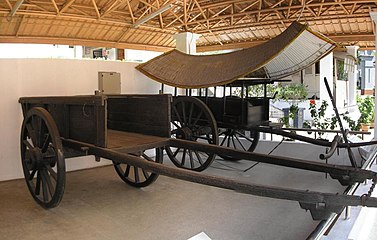
Carts from unlike Malay regions, exhibited at the Muzium Negara.
-

"Carreta", a type of cart of Argentina, 1864
-
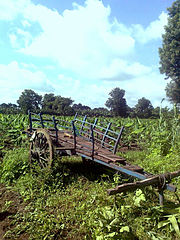
Cart with atomic number 26 wheels in a subcontract at Chinawal village, India
-
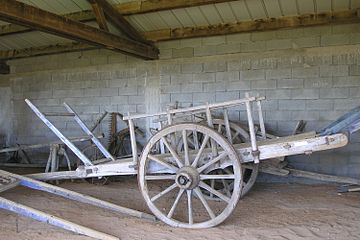
A charrette, a wooden French cart (Cévennes)
-

-

An iron-tyred wooden-spoked cart wheel
-
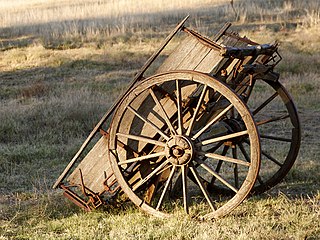
A uncomplicated wooden cart in Australia
-

A Chinese Sui Dynasty (581–618 Advertizement) cart figurine pulled by a bull
-

-

A walking cart, used for long distance travel, seen at Michigan's Mackinac Bridge
-

A Donkey Cart used for transporting goods in Northern part of Ghana
See also [edit]
- Araba
- Baggage cart
- Barouche
- Wheel trailer
- Brougham
- Bullock cart
- Cabriolet
- Carriage
- Carter (name)
- Cartwright
- Chariot
- Dicycle
- Dogcart (dog-fatigued)
- Float
- Governess cart
- Baby-sit stone
- Hand truck
- Hansom cab
- Hobcart
- Horse-drawn vehicles
- Jaunting auto
- Lorry (horse-fatigued)
- Michigan logging wheels
- Ralli automobile
- Red River ox cart
- Rickshaw
- Rully
- Serving cart
- Shopping cart
- Sicilian cart
- Sling cart
- Sprung cart
- Sulky
- Toy wagon
- Trolley (horse-drawn)
- Tumbril
- Un-sprung cart
- Wain
- War wagon
- Wheelbarrow
References [edit]
- ^ "Dray". Lexico Dictionaries: English . Retrieved October 15, 2020.
- ^ Lyndia Carter, "Handcarts," in Encyclopedia of Latter-day Saint History, 461–63.
- ^ CAAOnline: Carriage Tour. Archived October 27, 2007, at the Wayback Motorcar The Railroad vehicle Association of America, Inc.
- ^ pp. 61-62.
- ^ p. 279.
- ^ "Horse Drawn Carriages". Scalemodelhorsedrawnvehicle.co.uk. Retrieved August 25, 2014.
- ^ "Horse drawn vehicles in the 19th Century - Driffield Postal service Times". Driffieldtoday.co.uk. 2012-01-27. Archived from the original on Feb 20, 2015. Retrieved 2014-08-25 .
- ^ "RootsWeb: STAFFORDSHIRE-L [STAFFORDSHIRE] Whitechapel". Archiver.rootsweb.beginnings.com. July 1, 2014. Archived from the original on February 22, 2015. Retrieved August 25, 2014.
- ^ "Mobility and Wheelchair Assist - Alaska Airlines". Alaskaair.com. Retrieved October 15, 2020.
External links [edit]
- Hand and Horse Drawn Firefighting Apparatus Archived 2015-08-04 at the Wayback Machine
- History of the Shopping Cart

Source: https://en.wikipedia.org/wiki/Cart
Posted by: santeevortunfir.blogspot.com
0 Response to "Can My Service Dog Be Carried In My Own Cart"
Post a Comment